
Abstract
This study has been conducted by the researcher under a positivist paradigm while opting for the Quantitative approach. The study has been conducted while including 230 ESTs purposively and included in the study. All of the selected teachers were serving in FGEI's (C/G) Lahore region. The teachers' perspectives regarding their anxiety were measured with the help of a questionnaire comprising 30 items adopted from (Horwitz et al., 1986). On the other hand, the concerning teachers’ terminal GPA in English taken from the BISE results was taken to measure their performance. The results revealed an inverse and weaker effect of the teachers’ anxiety on their performance.
Key Words
Language Anxiety; Primary Teachers, Performance in English
Introduction
People are shaped via education in order to become civilized citizens. It acts as a border between nations that have advanced civilizations and those that have not. No nation can succeed without realizing the goal of education (UNESCO, 2019). The level of education in a country affects its future. They are the means through which the nation develops and thrives. They make their nation's finances better and make it sovereign (Zulfiqar, 2016; Parrish & Lanvers, 2019).
There are those who instruct others and aid in their quest for an appreciation of mankind and its experiences (Siddiqui et al., 2023). These are the teachers who work as hard as they can for the nation's education. Students are taught through both formal instruction and informal conversation (Asrar, Tariq, & Rashid, 2018). Man is special in that he can talk, unlike other living creatures. To accomplish their objectives, educators use it as a tool (Khan et al., 2017; Hakim, 2019). Students are more likely to comply with instructions when a teacher communicates well (Khan & Khan, 2017; Alamer & Vigentini, 2017).
Instructors need to be skilled communicators in order to convey their views easily and effectively (Ali et al., 2022; Bee, 2012; Munir et al., 2023). The teacher's responsibility is to guarantee the students’ learning. Instructions can only be successful when they are adequately conveyed (Loy, 2006). Both controlling the classroom and teaching require effective communication (Ehindero, 2000; Raheela et al., 2020). However, it has been observed that anxiety is faced by instructors dealing with and teaching the foreign language (Siddiqui et al., 2019; Noels, 2019). People with speech anxiety often acquire language anxiety as a result of their communication challenges (Alqahtani, 2019; Jawad & Al-Obaydi, 2015; Yasmeen et al., 2020). If a teacher speaks nervously, both the students' learning and the efficacy of the instructor's instructions may decrease (Tepeh, 2016).
Due to its widespread acceptance and rapid growth as a global language, it is now more important than ever to learn English (along with good communication skills) (Oga-Baldwin, 2017; Wang, 2010). However, English language learners frequently feel and express emotions like fear, stress, uneasiness, and concern while they struggle to acquire the needed proficiency and conversational abilities in the language (Ba?, 2014; McEown & Sugita-McEown, 2020). It can result in anxiety to the point that learners are absolutely unable to speak any English at all in really severe circumstances (Alamer, 2021).
Anxiety is a psychosomatic concept in psychology that is frequently characterized as a feeling of dread and terror as well as a vague apprehension generally linked with an item or occurrence (Mostafa & Ghonsooly 2015; Hashemi, 2010). Anxiety is a typical and natural emotion. Language learning suffers as a result of this reaction, making it one of the psychological issues in education that have generated the most study (Ryan & Deci, 2020; Ba? & Özcan, 2018; Zhou, 2016). State anxiety is described as the enduring and complex nature of some anxieties that may be triggered by a specific kind of state or stimulus and engaging in classroom activities (Teimouri, 2019; Zahid, Z., & Ghani, 2014).
Language anxiety is the term used to express the uneasiness or trepidation one experiences when speaking a language. According to Hismanoglu (2013), it is assumed that they are unable to communicate successfully in the target language. According to Alqahtani (2019) and Jawad and Al-Obaydi (2015), it is an unpleasant sensation and a challenge that comes with utilizing a language that is often a second language (Ali et al., 2017; Dewaele & Al-Saraj, 2015). Three categories have been created to further categorize anxiety: scenario-specific anxiety, anxiety connected to a particular situation, and anxiety related to personality traits (Tuncer, 2015; Tepeh, 2016).
It is found that teachers' performance was influenced by their anxiety while communicating in a language other than the primary one. Liu (2015), looked into the instructors' language anxiety and discovered that it affected their performance. There is a ton of knowledge available about students' anxiety. However, there is a paucity of studies on language anxiety among teachers. In order to fill this information vacuum, this study was carried out.
Statement of the Problem
Because English, which is not our first language, is now the language of instruction, the students are obligated to study it. However, they run across a number of challenges when they attempt to learn new languages. Language anxiety is a crucial component that has an impact on learning the English language (Tuncer, 2015). The goal of this study was to determine whether language anxiety affects teachers as well as students. What impact will the teachers' linguistic concerns have on their performance? This study set out to determine how instructors' concerns about language influenced their performance.
Significance of the study
According to MacIntyre and Gregersen (2012), language anxiety is a hindrance to students' progress and language acquisition. According to Zaman (2017), language anxiety prevents students from learning a second language, which has a detrimental impact on their academic performance (Chilton, 2019). English has been challenging since it influences students' academic performance and their anxiety connected to language acquisition (Halder, 2018; Yassin & Maasum, 2017).
Hismanoglu (2013) contends that giving students a less stressful environment will make it easier for them to learn. However, if the teachers are stressed, it could affect the students' performance and motivation. The communication skills of teachers affect their students' academic success and failure, claim Khan & Khan (2017). Several factors contribute to pupils' language anxiety and subpar academic performance, claims Ferhat (2011). The discussions among the instructors are one of them.
The teacher's personal anxiousness is assumed to have an effect on the students' academic progress. In this study, the instructors' anxiousness was investigated to see how it impacted the students' motivation and performance. The study's conclusions and recommendations will be helpful for teachers as they seek to lessen their language anxiety and increase student motivation and achievement.
Methodology
This study has been conducted by the researcher under a positivist paradigm while opting for the Quantitative approach. The study has been conducted while including 230 Elementary School Teachers (ESTs) purposively and included in the study. All of the selected teachers were serving in FGEI's (C/G) Lahore region. The teachers' perspectives regarding their anxiety were measured with the help of a questionnaire comprising 30 items adopted from (Horwitz, Horwitz, & Cope, 1986). This was ranged on five points Likert rating scale from Strongly agree to Strongly disagree with Cronbach's Alpha 0.71. On the other hand, the concerning teachers' terminal GPA in English taken from the BISE results was taken to measure their performance.
Data Analysis & Results
The data were evaluated and their central tendency and dispersion were determined using descriptive statistics. In a manner similar to this, Pearson's r was used. The detail is as under:
Table 1
| width="30%"> M width="39%">SD | > Teachers’ Anxiety width="30%">98.83 width="39%">16.03 | > Teachers’ Performance width="30%">2.22 width="39%">0.98 |
Table 2
| width="184"> Teachers’ Anxiety width="255">Teachers’ Performance | > Teachers’ Anxiety width="184">1 width="255">-.34 | > Teachers’ Performance width="184">width="255"> 1 |
Table 3
| R width="89">R Square width="121">Adjusted R Square width="84">df width="84">F width="69">Sig | > .346 width="89">.120 width="121">.116 width="84">1 width="84">31.06 width="69">.000 |
Table 4
| Model width="35%" colspan="4">Unstandardized Coefficients width="32%" colspan="2">Standardized Coefficients width="6%" rowspan="2">t width="8%" rowspan="2">Sig. | > B width="21%" colspan="2">Std. Error width="32%" colspan="2">Beta | > (Constant) width="13%" colspan="2">4.33 width="21%" colspan="2">.38 width="32%" colspan="2">width="9%" colspan="2"> 11.29 width="8%">.000 | > Teachers’ Performance width="13%" colspan="2">-.02 width="21%" colspan="2">.00 width="32%" colspan="2">-.34 width="9%" colspan="2">-5.57 width="8%">.000 | ||
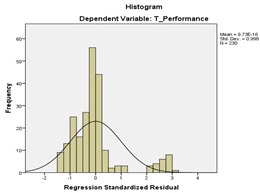
.The normal distribution of the data has been represented in Histogram 1 stated below:
Figure 1
Conclusion & Discussion
Because English, which is not our first language, is now the language of instruction, the students are obligated to study it. However, they run across a number of challenges when they attempt to learn new languages. Language anxiety is a crucial component that has an impact on learning the English language (Tuncer, 2015). What impact will the teachers' linguistic concerns have on their performance? This study set out to determine how instructors' concerns about language influenced their performance. Hismanoglu (2013) contends that giving students a less stressful environment will make it easier for them to learn. However, if the teachers are stressed, it could affect the students' performance and motivation. The communication skills of teachers affect their students' academic success and failure, claim Khan & Khan (2017). Several factors contribute to pupils' language anxiety and subpar academic performance, claims Ferhat (2011). The discussions among the instructors are one of them.
This study has been conducted by the researcher under a positivist paradigm while opting for the Quantitative approach. The study has been conducted while taking the Elementary School Teachers purposively included in the study. All of the selected teachers were serving in FGEI's (C/G) Lahore region. The teachers' perspectives regarding their anxiety were measured with the help of a questionnaire comprising 30 items. The concerning teachers’ terminal GPA in English taken from the BISE results was taken to measure their performance. The results revealed an inverse and weaker effect of the teachers’ anxiety on their performance.
References
- Alamer, A. (2021). Basic psychological needs, motivational orientations, effort, and vocabulary knowledge: Cambridge University Press, 44(1).
- Alamer, A., & Almulhim, F. (2021). The Interrelation Between Language Anxiety and Self-Determined Motivation; A Mixed Methods Approach. Frontiers in Education, 6.
- Ali, M. S. Z., Zubair, M. K., & Siddiqui, G. K. (2022). Investigating the Effect of School Teachers’ Behavior on Pupils’ Achievement. Global Social Sciences Review, VII(I), 70–77.
- Ali, N., Sharma, S., & Zaman, A. (2016). SCHOOL CULTURE AND SCHOOL EFFECTIVENESS: SECONDARY SCHOOLS IN PAKISTAN. Malaysian Online Journal of Educational Management, 4(4), 50–65.
- Alqahtani, S. M. (2019). The impact of language anxiety on EFL learners' proficiency: A case study of University of Jeddah. Adyala Journal, 844-864.
- Asrar, Z., Tariq, N., & Rashid, H. (2018). The Impact of Communication Between Teachers and Students: A Case Study of the Faculty of Management Sciences, University of Karachi, Pakistan. European Scientific Journal, ESJ, 14(16), 32.
- Baş, G. (2014). Foreign language anxiety in high school students: A qualitative study. Pamukkale Üniversitesi Eğitim Fakültesi Dergisi, 36, 101–119.
- Dalal, S. (2015). The Impact of Teachers’ Communication Skills on Teaching: Reflections of Pre-service Teachers on their Communication Strengths and Weaknesses.
- Chilton, M. (2019). Technology in the classroom: Using video links to enable long-distance experiential learning. Journal of Information Systems Education, 23(1), 51-55. Edchange:
- Dewaele, J.-M., & Al-Saraj, T. M. (2015). Foreign Language Classroom Anxiety of Arab learners of English: The effect of personality, linguistic and sociobiographical variables. Studies in Second Language Learning and Teaching, 5(2), 205.
- Ehindero. (2000). What our students say about how we teach. Education Studies, 1- 9.
- FGEI's. (2015, 9 17). Mission. Retrieved 9 17, 2015, from Fg Educational Institutions (c/g) Directorate Rawalpindi:
- GEM. (2019, 1 2). World education blog. Retrieved from Global education monitoring report:
- Hakim, B. M. (2019). A Study of Language Anxiety among English Language Learners in Saudi Arabia. Arab World English Journal, 10 (1) 64-72. DOI:
- Hashemi, M. (2010). An investigation of the factors that cause anxiety among the English students of the Islamic Azad University of Hamadan in learning speaking skills and its influence on their communication ability in the target language. Unpublished master’s/doctoral dissertation, Islamic Azad University of Hamadan: Hamadan, Iran.
- Hismanoglu, M. (2013). Foreign Language Anxiety of English Language Teacher Candidates: A Sample from Turkey. Procedia - Social and Behavioral Sciences, 93, 930–937.
- Horwitz, E. K., Horwitz, M. B., & Cope, J. (1986). Foreign Language Classroom Anxiety. The Modern Language Journal, 70(2), 125–132.
- Jawad, Z. A., & Al-Obaydi, L. H. (2015). Investigating the effect of language anxiety on student-teachers’ oral performance. In 8th Scientific Conference of the College of Education for Human Science/University of Diyala/2015. Diyala: University of Diyala.
- Khan, A., Khan, S., Syed, Z.-U.-I., & Khan, M. (2017). Communication Skills of a Teacher and Its Role in the Development of the Students’ Academic Success. Communication Skills of a Teacher and Its Role in the Development of the Students’ Academic Success, 8(1).
- Liu, H., & Chen, C. (2015). A Comparative Study of Foreign Language Anxiety and Motivation of Academic- and Vocational- Track High School Students. English Language Teaching, 8(3).
- Loy, K. J. (2006). Kevin John Loy. (Unpublished Doctoral Thesis) The Ohio State University.
- MacIntyre, P., & Gregersen, T. (2012). Affect: The Role of Language Anxiety and Other Emotions in Language Learning. Psychology for Language Learning, 103– 118.
- McEown, K., & Sugita-McEown, M. (2020). The role of positive and negative psychological factors in predicting effort and anxiety toward languages other than English. Journal of Multilingual and Multicultural Development, 1–13.
- Amiri, M., & Ghonsooly, B. (2015). The Relationship between English Learning Anxiety and the Students’ Achievement on Examinations*. Journal of Language Teaching and Research, 6(4), 855.
- Munir, H., Fatima, Q., Navid, P., & Malik, J. (2023). Role Of Teacher As E-Leadership In Students Learning : A Viewpoint Of University Students, Journal of Positive School Psychology 7(1), 70–78.
- Noels, K. A., Vargas Lascano, D. I., & Saumure, K. (2019). THE DEVELOPMENT OF SELF- DETERMINATION ACROSS THE LANGUAGE COURSE. Studies in Second Language Acquisition, 41(04), 821–851.
- Oga-Baldwin, Q., Nakata, Y., Parker, P., and Ryan, R. (2017). Motivating young language learners: a longitudinal model of self-determined motivation in elementary school foreign language classes. Contemp. Educ. Psychol. 49, 140– 150
- Parrish, A., and Lanvers, U. (2019). Student motivation, school policy choices and modern language study in England. Lang. Learn. J. 47, 281–298.
- Ryan, R. M., & Deci, E. L. (2020). Intrinsic and Extrinsic Motivation from a self- determination Theory perspective: Definitions, theory, practices, and Future Directions. Contemporary Educational Psychology, 61(1), 1–11.
- Rashid, K. Y., & Mukhtar, S. (2012). Education in Pakistan: Problems and their Solutions. International Journal of Academic Research in Business and Social Sciences, 2(11), 232–343.
- Teimouri, Y., Goetze, J., & Plonsky, L. (2019). SECOND LANGUAGE ANXIETY AND ACHIEVEMENT: A META-ANALYSIS – ERRATUM. Studies in Second Language Acquisition, 41(2), 489–489.
- Tepeh, I. (2016). Language Anxiety: teachers' and learners' perspectives. University of Zagreb (Unpublished Doctoral Thesis).
- Siddiqui, G. (2019). In-Service Training at Federal Government Educational Institutions (Cantts/ Garrisons): Investigating Trainees’ Perspectives about Trainers’ Practices. Pakistan Social Sciences Review, 3(II), 713–723.
- Siddiqui, G. K., Shahid, M., Ali, Z., Zarar, N., & Munir, H. (2023). Public Education System In Pakistan : An Exploration Into Major Problems. Journal of Positive School Psychology 7(1), 1311–1323.
- Tuncer, M., & Doğan, Y. (2015). Effect of Foreign Language Classroom Anxiety on Turkish University Students’ Academic Achievement in Foreign Language Learning. Journal of Education and Training Studies, 3(6).
- UNESCO. (2019, January 2). Gender equality and education. United Nations Educational, Scientific and Cultural Organization.
- UNICEF. (2019, January 2). Gender equality in primary and secondary education. UNICEF:
- Wang, S. (2010). An Experimental Study of Chinese English Major Students’ Listening Anxiety of Classroom Learning Activity at the University Level. Journal of Language Teaching and Research, 1(5).
- Wikipedia contributors. (2023). Sex differences in education. Wikipedia.
- Yasmin, T., Nadeem, M., Siddique, G. K., & Ali, M. (2020). The Effect of Teachers’ Language Speaking Anxiety on their Performance in English. Review of Education, Administration and Law.
- Zahid, Z. (2014.). An Association of Learners’ Attitude with Anxiety: Effects and Implications. Retrieved July 16, 2023, from
- Zhou, M. (2016). The roles of social anxiety, autonomy, and learning orientation in second language learning: A structural equation modeling analysis. System, 63, 89–100.
- Zulfiqar, M. S. (2016). Teachers' perceptions about in-service training at federal government educational institutions (cantts/garrisons). Lahore: University of Education, Lahore (Unpublished MPhil Thesis).
Cite this article
-
APA : Afzal, A., Ali, M. S. Z., & Asghar, S. (2023). English Language Anxiety: Investigating the Effect on Primary School Teachers' Performance. Global Educational Studies Review, VIII(II), 399-406. https://doi.org/10.31703/gesr.2023(VIII-II).36
-
CHICAGO : Afzal, Ashfaq, Muhammad Shahid Zulfiqar Ali, and Suneeta Asghar. 2023. "English Language Anxiety: Investigating the Effect on Primary School Teachers' Performance." Global Educational Studies Review, VIII (II): 399-406 doi: 10.31703/gesr.2023(VIII-II).36
-
HARVARD : AFZAL, A., ALI, M. S. Z. & ASGHAR, S. 2023. English Language Anxiety: Investigating the Effect on Primary School Teachers' Performance. Global Educational Studies Review, VIII, 399-406.
-
MHRA : Afzal, Ashfaq, Muhammad Shahid Zulfiqar Ali, and Suneeta Asghar. 2023. "English Language Anxiety: Investigating the Effect on Primary School Teachers' Performance." Global Educational Studies Review, VIII: 399-406
-
MLA : Afzal, Ashfaq, Muhammad Shahid Zulfiqar Ali, and Suneeta Asghar. "English Language Anxiety: Investigating the Effect on Primary School Teachers' Performance." Global Educational Studies Review, VIII.II (2023): 399-406 Print.
-
OXFORD : Afzal, Ashfaq, Ali, Muhammad Shahid Zulfiqar, and Asghar, Suneeta (2023), "English Language Anxiety: Investigating the Effect on Primary School Teachers' Performance", Global Educational Studies Review, VIII (II), 399-406
-
TURABIAN : Afzal, Ashfaq, Muhammad Shahid Zulfiqar Ali, and Suneeta Asghar. "English Language Anxiety: Investigating the Effect on Primary School Teachers' Performance." Global Educational Studies Review VIII, no. II (2023): 399-406. https://doi.org/10.31703/gesr.2023(VIII-II).36